
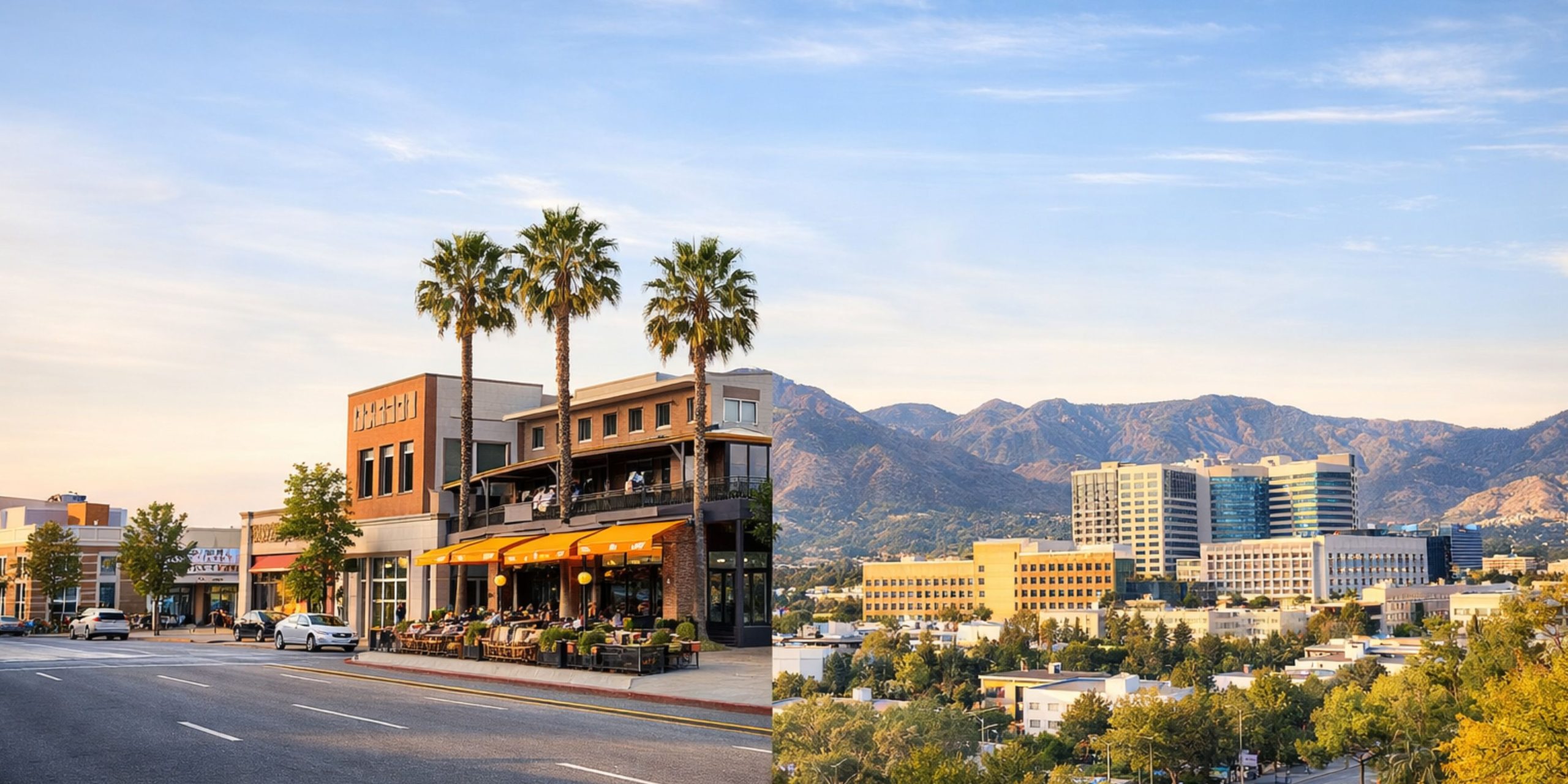
Burbank Commercial Real Estate: What Investors Must Know 2026
Burbank has quietly cemented itself as one of the most resilient commercial real estate markets in all of Los Angeles County. While broader LA submarkets continue wrestling with elevated vacancies and post-pandemic repositioning, Burbank keeps drawing serious investor capital — and the reasons are structural, not speculative.
Anchored by world-class media and entertainment employers, thriving retail corridors along Magnolia Blvd and Victory Blvd, and a city government that actively supports mixed-use redevelopment, commercial real estate in Burbank continues to deliver steady demand, healthy transaction volume, and long-term appreciation potential well into 2026.
In this post, the team at DMC Real Estate breaks down the latest sales data, current market drivers, what smart buyers and investors should be watching right now, and where the Burbank CRE market is headed for the rest of 2026.
Recent Commercial Property Sales in Burbank
The best read on any market isn’t the headlines — it’s the transaction data. Here are three notable commercial sales that illustrate what’s happening on the ground in Burbank:
|
Property |
Sale Price |
Building Size |
Lot Size |
Date Sold |
Key Notes |
|
3108 W Magnolia Blvd |
$1,650,000 |
~1,925 sq ft |
~2,672 sq ft |
August 2025 |
Small-format retail — ideal for niche restaurant, boutique, or service business |
|
3400–3408 W Victory Blvd |
$3,315,200 |
~5,328 sq ft |
~10,488 sq ft |
July 2025 |
Mid-size multi-tenant building; lot depth allows for parking expansion |
|
4301 W Riverside Drive |
$3,900,000 |
~13,152 sq ft |
~19,019 sq ft |
February 2025 |
Restaurant-anchored with large surface parking; premium paid for visibility and access |
These transactions tell a consistent story heading into 2026: Burbank buyers are paying for location, lot utility, and tenant-ready infrastructure — not just square footage. That discipline is what separates this market from more speculative corners of the LA basin.
What These Sales Tell Us About the Burbank Market in 2026
Strong Demand for Mixed-Use and Restaurant-Friendly Properties
The Riverside Drive transaction at $3.9M is the clearest signal in the data. Buyers paid a significant premium for a restaurant-anchored asset with dedicated parking — a combination that is increasingly rare on Burbank’s most competitive corridors. In a market where foot traffic and accessibility define retail performance, properties with ground-floor restaurant potential and surface parking command pricing well above standard commercial comparables. That dynamic is only intensifying in 2026 as experiential retail continues to outperform.
Lot Size Is Often the Real Value Driver
On Victory Blvd, the ~10,488 sq ft lot is as important as the building itself. Investors in Burbank are increasingly evaluating expansion potential, surface parking capacity, and future development optionality as primary value drivers. In some transactions, the land value equals or exceeds the value of the existing structure — especially within Burbank’s key commercial corridors where infill density is growing.
For investors interested in understanding how combining adjacent parcels can unlock additional value, our overview of acquisitions and dispositions strategy goes deeper on land assemblage opportunities in markets like Burbank.
Price Per Square Foot Reflects a Durable Location Premium
The Magnolia Blvd transaction at $1.65M for under 2,000 sq ft reflects a price-per-square-foot reading that would seem aggressive in many other LA submarkets — but is entirely consistent with Burbank’s premium positioning. Smaller, well-located buildings in Burbank routinely outperform larger assets on a per-square-foot basis because tenant demand in prime spots remains exceptionally durable, even as the broader office market softens nationally.
Healthy Liquidity Signals Ongoing Investor Confidence
All three benchmark properties sold within a compressed window — a meaningful indicator in itself. Active deal flow signals that buyers still see clear upward potential, whether through repositioning, value-add renovation, or holding stabilized income through a rate normalization cycle. As capital market conditions continue to improve in 2026, Burbank is positioned to be among the first SoCal submarkets to see a meaningful uptick in transaction volume. Savvy investors are increasingly leveraging real estate investor tools to analyze these trends, identify opportunities, and make data-driven investment decisions in this dynamic market.
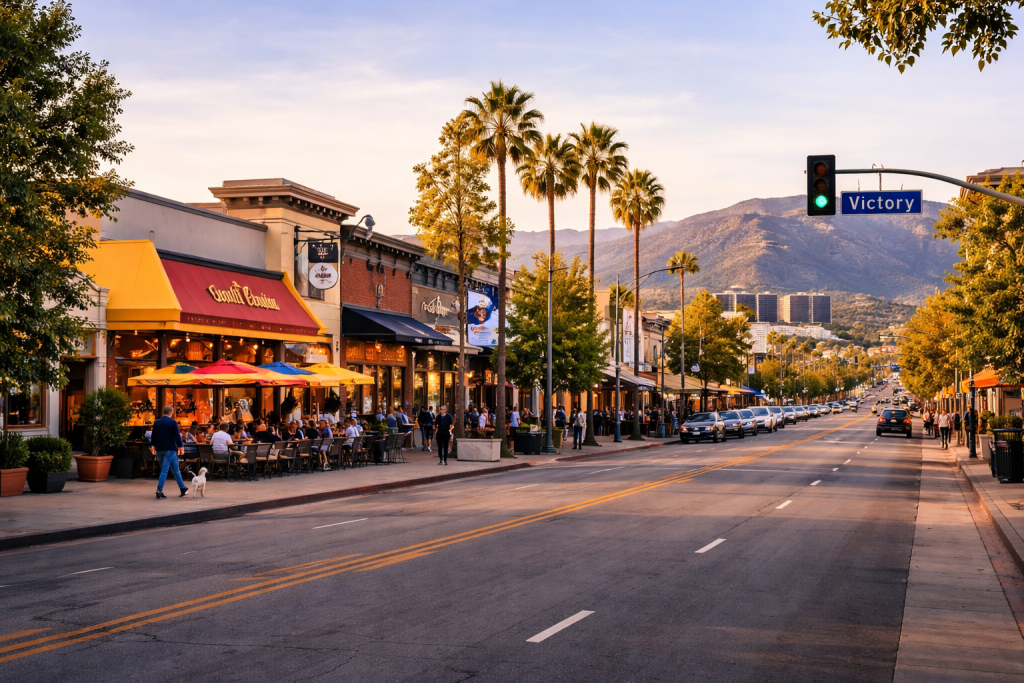
Why Burbank Continues to Attract Commercial Real Estate Investors in 2026
1. A Structurally Stable Employment Base
Burbank’s economy is anchored by global media and entertainment companies — Warner Bros., Disney, Nickelodeon, and Cartoon Network all maintain significant operations here. This isn’t cyclical employment — it’s institutional. Institutional employment generates consistent, year-round demand for office, retail, and mixed-use commercial space regardless of broader economic conditions.
That stability is something most LA submarkets simply cannot replicate. Markets outside the City of Los Angeles proper — including Burbank — are positioned to outperform city-adjacent submarkets in part because they’re insulated from the impact of Measure ULA on transaction economics, a factor that continues to suppress deal volume inside city limits in 2026.
2. Strategic Location Between LA and the San Fernando Valley
Burbank occupies a logistical intersection that few cities can match: immediate freeway access via the 5, 134, and 170, proximity to Hollywood Burbank Airport, and a central position between Downtown Los Angeles and the San Fernando Valley. For businesses that need to serve a wide geographic footprint — from media production crews to regional retail operators — Burbank is often the single smartest operational choice, translating directly into durable commercial tenant demand.
3. Thriving Retail Corridors With Built-In Foot Traffic
Magnolia Park, Downtown Burbank, and Victory Blvd represent three distinct but consistently high-performing retail corridors. Unlike many suburban commercial corridors that have struggled with post-pandemic behavioral shifts, Burbank’s retail streets benefit from a dense residential base, genuinely walkable streetscapes, and a local consumer with above-average disposable income. Nationally, the retail sector continues to post some of its strongest occupancy numbers in nearly two decades — and Burbank’s retail vacancy tracks even tighter than national averages.
4. City-Level Support for Mixed-Use and Adaptive Reuse
Burbank’s planning and zoning framework has consistently backed redevelopment, particularly in commercial corridors where adaptive reuse and mixed-use projects qualify for streamlined approvals. This policy environment materially reduces development risk and improves the feasibility of value-add projects — a significant differentiator for investors evaluating multiple Southern California markets simultaneously.
If you’re currently evaluating a Burbank commercial property for repositioning potential, our commercial brokerage team can provide a full feasibility and market analysis at no cost.
Key Market Data: Burbank CRE in 2026
Here’s where the Burbank commercial real estate market stands as we move through 2026, benchmarked against national data:
| Metric | Burbank / SoCal Context | National Benchmark (2026) |
| Retail Vacancy Rate | Below regional average; prime corridors near full occupancy | ~4.5% nationally — historically low |
| Industrial Vacancy | Tight; entertainment/production demand supports occupancy | ~7.2% nationally (modest rise from 2025) |
| Office Vacancy | Creative office strong; traditional Class B/C under pressure | ~20%+ nationally (continued elevation) |
| Renter Occupancy | ~57% of Burbank housing is renter-occupied | Supports mixed-use viability across all corridors |
| Average 1-BR Rent | ~$2,300–$2,450/month (2026 estimate) | Supports strong retail consumer spending base |
| CRE Transaction Volume | Recovering; improved lender appetite in H1 2026 | Up from 2025 lows as rate cycle stabilizes |
What Smart Buyers and Investors Should Be Watching in 2026
Due Diligence on Parking and Access
In Burbank, parking is not a secondary underwriting variable — it is often the primary value driver. Properties with restricted ingress/egress or inadequate surface parking consistently underperform their higher-access competitors, regardless of how well the building presents. Always evaluate total parking ratio (spaces per 1,000 sq ft of leasable area) before submitting an offer. This is especially critical on Magnolia and Victory Blvd where street parking is constrained.
Tenant Mix and Lease Structure
Multi-tenant retail in Burbank performs best when an anchor tenant stabilizes foot traffic for surrounding smaller users. A single large-footprint anchor locked into a below-market, long-term lease may appear stable on paper but significantly limits upside. The optimal 2026 acquisition target has a blend of long-term tenants providing income stability and near-term lease expirations creating mark-to-market rent growth opportunities over a 3–5 year hold.
Office vs. Creative Office: Two Very Different Stories
National office vacancy continues to register above 20% — a historic high. But that number does not apply uniformly to Burbank. Traditional Class B and C office space is under meaningful pressure here as it is everywhere. Creative office — production-ready, high-ceiling, flexible-use space serving entertainment and media tenants — remains in consistently strong demand. If you’re evaluating office product in Burbank in 2026, the sub-category within office matters as much as the address.
Building Condition and Capital Expenditure Risk
Older buildings on key Burbank corridors can be exceptional value-add opportunities — but only if the capital expenditure budget is calculated before the offer, not after. Retrofitting costs, seismic compliance under California’s current Title 24 standards, ADA upgrades, and MEP systems replacements can add $30–$80 per square foot depending on vintage and condition. DMC provides pre-offer due diligence support to ensure our clients price these risks into their underwriting — not discover them post-close.
Interest Rates and Financing Conditions in 2026
The financing environment in 2026 is meaningfully improved from the peak-rate conditions of 2023–2024. Lenders are returning to the market with more competitive LTV ratios and tighter spreads over benchmark rates, and the debt service coverage math on stabilized Burbank retail and industrial is workable again for well-qualified buyers. In Burbank, prime retail cap rates typically range from 4.5% to 5.5% — maintaining a positive spread over current financing rates for buyers with strong equity positions.
For investors who own appreciated LA-area commercial properties and are considering a tax-efficient exit in 2026, our 1031 exchange guidance covers exactly how to defer capital gains and redeploy into a stronger-positioned Burbank or SoCal replacement asset.
2026 Outlook: Burbank CRE Trends to Watch
Adaptive Reuse and Mixed-Use Conversions Will Accelerate
Underutilized industrial and standalone retail buildings in Burbank’s inner corridors are prime candidates for mixed-use conversion in 2026 — particularly where zoning allows residential components above ground-floor commercial. California’s evolving infill housing legislation continues to improve the entitlement environment for these projects, and Burbank’s planning department has historically been among the more developer-friendly in the region. The risk/return profile for well-located adaptive reuse projects is compelling for patient capital.
ESG and Sustainability Features Are Now Pricing Factors
Green-certified buildings represent a growing share of new commercial construction nationally, and the gap in lease rates between energy-efficient and non-compliant assets is widening. In Burbank — where major studio and entertainment tenants have published sustainability commitments — energy efficiency upgrades, EV charging infrastructure, and LEED or ENERGY STAR certifications are increasingly factoring into both lease negotiations and acquisition pricing. Assets upgraded for sustainability now will trade at a premium in the next liquidity cycle.
Creative Office and Production Space Demand Stays Structural
Burbank’s identity as the media capital of California is not a cyclical story — it’s a structural one. As the entertainment industry evolves through streaming proliferation, AI-assisted content production, and immersive media formats, the demand for specialized, production-ready commercial space in Burbank will grow alongside it. Spaces with high clearance heights, heavy power capacity, flexible column grids, and soundproofing capacity remain consistently undersupplied relative to tenant demand. This is one of the most durable investment theses in the entire LA market.
Retail Corridor Reinvestment Continues
Magnolia Park and key segments of San Fernando Blvd are already attracting private investment in storefront modernization, public realm improvement, and streetscape enhancement. As residential density in central Burbank deepens — driven by infill development and transit-oriented projects near the Metrolink station — the consumer base supporting Burbank’s retail corridors will strengthen over the next 3–5 years. Well-located retail in these corridors is positioned to see rent growth outpace the broader LA market through at least 2028.
Frequently Asked Questions About Commercial Real Estate in Burbank
Is Burbank commercial real estate a good investment in 2026?
Yes — Burbank remains one of the most stable and defensible commercial real estate markets in Los Angeles County. Its institutional employment base, tight retail vacancy, city-supported mixed-use redevelopment framework, and insulation from Measure ULA make it consistently attractive for investors across retail, industrial, and creative office asset classes. The improving financing environment in 2026 makes entry more accessible than at any point since 2022.
What types of commercial properties are available in Burbank?
Burbank offers a full spectrum of commercial property types: retail storefronts along Magnolia and Victory Blvd, creative and production office space, industrial and flex buildings near the Hollywood Burbank Airport corridor, and mixed-use properties in the downtown core. Multi-family investment properties also trade actively in the area — explore our guide to multi-family apartments in the LA area for context on adjacent residential investment opportunities.
What cap rates are typical for Burbank commercial properties in 2026?
Cap rates for stabilized retail and creative office in Burbank typically range from 4.5% to 5.5% for prime product. Industrial and value-add assets may offer higher initial yields in the 5.5%–6.5% range. Burbank is a low-risk, high-stability market that attracts institutional buyers who accept slightly compressed cap rates in exchange for tenant quality, covenant strength, and long-term appreciation.
How does Burbank compare to other LA commercial real estate markets?
Burbank consistently outperforms most LA submarkets on tenant stability, vacancy rates, and transaction liquidity. It is largely insulated from the Measure ULA transfer tax that continues to suppress deal activity inside City of LA boundaries — a meaningful advantage for both buyers and sellers in 2026. For investors evaluating the broader San Fernando Valley corridor, North Hollywood commercial real estate and Studio City commercial real estate are the two most comparable adjacent markets worth analyzing.
Should I do a 1031 exchange into a Burbank property in 2026?
Burbank makes an excellent 1031 exchange destination for investors seeking a stable, institutional-quality replacement property. The combination of durable tenant demand, below-average vacancy, and improving financing conditions creates a favorable entry point in 2026. DMC has guided numerous clients through 1031 exchanges out of California and into well-positioned SoCal assets. Contact us to discuss your specific timeline, equity position, and replacement property criteria.
What is the outlook for Burbank’s retail market in 2026?
Burbank’s retail market is one of the strongest in the San Fernando Valley. Prime corridors — Magnolia Park, Downtown Burbank, and Victory Blvd — are operating near full occupancy with limited new supply entering the market. Rent growth in non-anchored strip retail and restaurant-positioned properties is expected to continue at 3%–5% annually through 2027, supported by rising residential density and a high-spending local consumer base.
Work With Burbank’s Commercial Real Estate Specialists
The Burbank market in 2026 rewards investors who understand its nuances — from parking requirements on key corridors, to the meaningful difference between creative office and traditional office product, to the value unlocked by near-term lease expirations in multi-tenant retail. Getting these details right is the difference between a good deal and a great one.
At DMC Real Estate & Investments, we’ve spent nearly 20 years working the San Fernando Valley and Greater Los Angeles commercial market. Our team is led by Simon Asef, CCIM — one of fewer than 10,000 commercial real estate professionals nationwide to hold that credential — backed by a full-service brokerage built specifically for investment-oriented buyers, sellers, and developers.
We have access to off-market Burbank opportunities that never hit the public listing portals, and we provide a complete investment lifecycle service: acquisition sourcing, due diligence support, financing connections, value-add strategy, and eventual disposition or 1031 exchange into your next asset.
Whether you’re evaluating a specific Burbank property, building a San Fernando Valley portfolio, or planning a strategic 2026 sale, we’re ready to help you make the right move.
📞 (818) 761-4252 ext. 102 🌐 dmcinvestments.com/contact 📍 11104 Magnolia Blvd, North Hollywood, CA 91601