

Top 10 Tools Every Real Estate Investor Should Use in 2026
The field of real estate investing is changing quickly, and in 2026 and beyond, having the correct Real Estate Investor Tools will be crucial for managing assets, spotting opportunities, and maximizing earnings.
Why Tools for Real Estate Investors Matter in 2026
In today’s data-driven market, using the Top tools every real estate investor should use in 2026 isn’t just smart — it’s essential. Whether you are analyzing deals, automating operations, tracking market trends, or managing tenant communications, the right Tools for Real Estate Investors empower you to act with speed, accuracy, and confidence.
The Foundation: What Makes Great Real Estate Investor Tools
Before we explore specific tools, it’s important to understand what separates good from great:
Accuracy — Tools must deliver reliable data and forecasts.
Speed — Real estate moves fast; slow tools cost opportunities.
Integration — Best tools work well together across platforms.
Scalability — They grow with your portfolio.
Usability — Easy adoption reduces training time and errors.
Top 10 Real Estate Investor Tools for 2026
Here are the most impactful Real Estate Investor Tools, including platforms for assemblage real estate, that the most successful investors are relying on this year:
1. Market Analytics Platforms
These tools help you track pricing trends, rental demand, demographic patterns, and economic indicators to identify where and when to invest.
Key Benefits
- Local and national trend reports
- Automated valuation models
- Investment opportunity alerts
2. Deal Analysis Software
Move beyond spreadsheets. These tools calculate cash flow, ROI, cap rates, IRR, and sensitivity scenarios quickly and accurately.
Key Benefits
- Fast underwriting comparisons
- Built‑in calculators for financing scenarios
- Visual dashboards for investor presentations
3. CRM and Lead Management
Use tools created to monitor conversations, follow‑ups, and sources of leads for the purpose of developing a pipeline.
Key Benefits
- Automated follow‑ups
- Centralized contact database
- Integrated marketing campaigns
4. Property Management Solutions
From rent collection to maintenance requests, these tools keep tenants happy and landlords organized.
Key Benefits
- Tenant portals
- Online rent payments
- Maintenance ticket tracking
5. Legal and Compliance Tools
Preserve your investments by using tools that will aid in managing contracts, eSignatures, lease templates and regulatory requisites.
Key Benefits
- Secure digital contracts
- Legal templates updated to local laws
- Audit trails for compliance
6. Financial Tracking and Accounting Software
The handling of finances becomes intricate regardless of the number of buildings you own; they can be just one or as many as fifty. The mentioned utilities maintain distinct records, generate reports automatically, and contribute to the planning of taxes.
Key Benefits
- Expense categorization
- Real‑time profit/loss statements
- Integration with banks and payroll
7. Communication and Collaboration Tools
When it comes to working with teams, partners, or contractors, the communication tools guarantee that everyone is on the same wavelength and that the work is done quickly.
Key Benefits
- Real‑time messaging
- Shared workflows
- Document collaboration
8. Construction and Renovation Management
For value‑add investors, these tools keep projects on budget and on schedule.
Key Benefits
- Budget tracking
- Contractor communication
- Timeline visualization
9. Virtual Tour and Marketing Tools
Stand out in a crowded market with immersive property tours and professional marketing campaigns.
Key Benefits
- 3D walkthroughs
- Integrated listing syndication
- Analytics on viewer engagement
10. Learning and Community Platforms
Great investors are forever students. Networking and mentoring courses keep all tools sharp.
Key Benefits
- Peer forums
- Expert webinars
- Strategy workshops
Tool Comparison Table
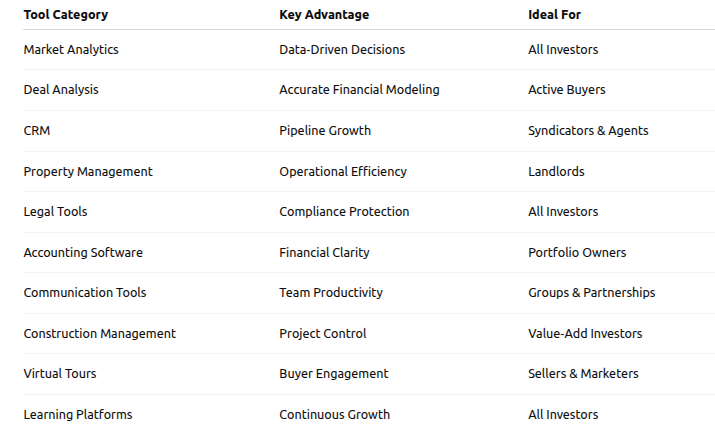
This table demonstrates the extent to which different Real Estate Investor Tools cater to the particular requirements of investors, irrespective of whether you are assessing your initial deal or overseeing a substantial rental portfolio.
How These Tools Work Together
Great investors do not rely on any one tool. They set up a tool ecosystem where the data is easily accessible and decision-making is based on real-time insights, and the time spent on administration is so reduced that strategic thinking is given a larger share of the time.
For example:
- A market analytics platform feeds data into your deal analysis software.
- CRM tools sync contact and lead information with email marketing and communication tools.
- Property management solutions tie into accounting software for accurate financial reporting.
The integrated view of different elements is what separates amateurs from professionals.
Expert Insight
According to leading real estate strategist Anna Morales, “The investors who win in 2026 are those who treat Real Estate Investor Tools not as optional extras, but as essential infrastructure. When your tools work for you, not against you, you invest more confidently and grow faster.”
Real World Example
At DMC Real Estate & Investments, we saw dramatic improvements after implementing a comprehensive tool stack:
Before
- Manual spreadsheets led to slow deal reviews.
- Communication gaps cost follow‑ups.
After
- Deal analysis software reduced evaluation time by 50%.
- CRM automated follow‑ups boosted conversion rates.
- Property management tools improved tenant satisfaction.
Investors working with DMC reported faster decision cycles and better portfolio performance — a testament to choosing the Top tools every real estate investor should use in 2026.
FAQs
What are must‑have tools for new real estate investors?
New investors should start with deal analysis software, market analytics, and a CRM platform to build a strong foundation.
Can small investors benefit from advanced tools?
Absolutely — even solo investors see big gains in accuracy and efficiency by adopting the right Real Estate Investor Tools.
Do these tools cost a lot?
Prices vary from free tiers to subscription plans. Focus on tools that deliver ROI rather than choosing based on price alone.
How do I choose tools that work together?
Prioritize platforms with integration capabilities via APIs or native partnerships so data flows seamlessly between tools.
Will tools replace human judgment in investing?
No — tools enhance decision‑making but do not replace investor strategy, analysis skills, or market insight.
Conclusion
In the ever‑competitive world of real estate investing, equipping yourself with the best Real Estate Investor Tools isn’t just helpful — it’s transformative. The Top tools every real estate investor should use in 2026 enable smarter underwriting, efficient operations, better tenant experiences, and stronger financial performance.
At DMC Real Estate & Investments, we believe the right tools are the backbone of success — empowering investors of all levels to make data‑backed decisions, automate routine tasks, and focus on growth. Build your tool stack wisely in 2026 and watch your real estate journey reach new heights.